Showing posts with label Current Events. Show all posts

Friday, May 6, 2016

Maryland Primary Races Bring No Surprises; Baltimore Mayoral Primary Incomplete

By Neel Lakhanpal '16


Maryland was among a string of Northeastern states last week to solidify the leads of the two respective presidential front-runners. With Donald Trump now running uncontested and Hillary holding a commanding lead (despite her loss in Indiana), we are all but assured of who will be our presidential candidates this cycle. Additionally, primaries were held for the new Senate vacancy left by the outgoing Barbara Mikulski, as were mayoral primaries for Baltimore.

Maryland was a classic state to support Clinton and Trump in the primaries. Clinton was benefitted by our large African-American population and our other similarities to more Southern states, in which she has done very well this year. We were also the archetype of a state in which Trump does well. He has flourished in blue states during the primaries because the Republicans that live in them tend to be even more “angry” and thereby politically energized to vote for him. Maryland being such a blue state, Trump had a distinct advantage. Additionally, Maryland Republicans have recently been even more galvanized due to the surprise victory two years ago of Larry Hogan. Although still dwarfed in number by Democrats, Maryland Republicans are feeling more relevant than before with Hogan in office. These factors combined to have us elect Trump and Hillary by wide margins.

The Senate Democratic primary ended in a victory for Chris Van Hollen, who soundly defeated Donna Edwards 53% to 38%. Both are current Maryland representatives in the House; Edwards represents Severna Park, Pasadena, and parts of PG country while Van Hollen represents the DC suburbs of Bethesda and Rockville. Van Hollen relied on the strong support of his district’s constituents. Edwards, however, largely failed to mobilize the black vote on which she was relying despite being an African-American woman. Many African Americans instead voted for Van Hollen. Since Maryland will almost certainly elect Van Hollen over the Republican primary winner Kathy Szeliga, we can count on Van Hollen replacing Mikulski’s seat this fall.

Lastly, and most interestingly, the primaries did not settle the Democratic primary for mayor of Baltimore. As of now, political outsider Catherine Pugh holds a lead of a couple thousand votes over former Baltimore mayor Sheila Dixon. However, there are still provisional and absentee ballots being processed, and there is no official count as of yet. It is also possible that Dixon will request a recount when the final number arrives because of just how close the numbers are. We will have wait and see who Baltimore ultimately elects. 

Image courtesy of The Baltimore Sun. 


Read More »

Wednesday, April 13, 2016

Baltimore Mayoral Race Approaches; Voters Look for Change:


By Neel Lakhanpal ‘16


I think it is safe to assume that you either have not heard anything about the upcoming Baltimore mayoral race or have heard it mentioned once or twice but know nothing about who’s running. Among these reasons is certainly the presidential race casting a shadow over all over politics in the nation, especially several key Congressional races. Not only is this election cycle very different than previous ones, but it is also one that has dominated news outlets, easily grabbing the attention of readers and watchers around the country.

Nonetheless, this election is an important one. Stephanie Rawlings-Blake, the current mayor, decided months ago not to launch a campaign for re-election after the racial unrest that rocked the city last April. Her handling of the situation itself and the internal personnel switches that she made in the wake of the unrest tarnished her reputation and made her candidacy unviable. The next mayor, whoever it ends up being, will be presented with a tough bill to alleviate racial tension in this new era of the Black Lives Matter Movement and increased scrutiny of police brutality.

However, voters are aware that this mayor must also tackle the roots of these problems. In a recent poll conducted by the Baltimore Sun, the most cited “biggest concern” was “crime, ”after which were “youth and education” and “job creation.” As such, Baltimoreans want a mayor who will handle both the crime that plagues the city and the systemic causes of poor education and joblessness that drive it.

As of now, there are two leaders and over a dozen others behind them. Former Baltimore Mayor Sheila Dixon and State Senator Catherine Pugh are currently tied for top place in most polls. While Dixon is warmly received by Baltimoreans because of her successful tenure as mayor years ago, she is still suffering somewhat from a conviction of misdemeanor perjury during her time in office that forced her to step down. She is pitching herself as a seasoned politician who made a mistake, and is so far benefitting from that approach. On the other hand, Pugh is making the case that she is a more energetic political outsider. In this year of the outsider, that aura is benefitting her, too. The rest of the candidates are little known but incredibly diverse. They range greatly in age, political experience, and political affiliation. Rounding out the 21 total candidates are five Republicans and surprisingly three Greens. A majority of the candidates are African-American, as is the population of the city.

All parties’ primaries are held on April 26th, as will the primaries for the presidential and Congressional elections for Maryland. Since Baltimore is so heavily blue (there are 10 Democrats to every Republican), the winner of the Democratic primary all but decides who will be the next mayor of Baltimore. Barring any surprises in the general election come November, we can be pretty certain of who the mayor-elect will be in just a few weeks.

Information and image courtesy: www.baltimoresun.com
Read More »

Thursday, March 3, 2016

How White are the Oscars?

By: Zachary Rosen '16

Since the announcement of Oscar nominations a few weeks ago, the Academy has come under fire after another year without any people of color nominated for any of the acting categories. Various industry professionals, such as Spike Lee and Jada Pinkett and Will Smith, have publicly criticized this dearth of diversity and did not attend the academy awards on Sunday. Chris Rock, the host this year, also touched upon this issue extensively over the course of the evening. So, in the midst of all this controversy, we must ask the question: is the Academy racist? Though the question is simple, the answer is much more complicated.

One can look at the problem from a purely statistical perspective: each acting category has five nominees every year; since the year 2000 (which is the arbitrary bench mark for this article), there have been 85 nominations in each category. For this article, we will use 2010 census data available on Wikipedia, which indicates that African Americans make up 12.6 percent of the U.S. populations, Asian Americans make up 4.8 percent of the U.S. population, and Hispanic Americans make up 16.3 percent of the U.S. population.

Since 2000, there have been ten nominations for black lead actors (11.8 percent), four for black lead actresses (4.7 percent), six for black supporting actors (7.1 percent), and nine for black supporting actresses (10.6 percent). These are all lower than the 12.6 percent for the U.S. population.

Since 2000, there has been one nomination for an Asian lead actor (1.2 percent), no nominations for an Asian lead actress (there has actually only been one, ever, in 1935), two for Asian supporting actors (2.4 percent), and three for Asian supporting actresses (3.5 percent). These are all lower than the 4.8 percent for the U.S. population.

Since 2000, there have been five nominations for Hispanic lead actors (5.6 percent), three for Hispanic lead actresses (3.5 percent), four for Hispanic supporting actors (4.7 percent), and five for Hispanic supporting actresses (5.6 percent). These are all lower than the 16.3 percent for the U.S. population.

It is important to note that the Academy Awards reflect the talents of actors from across the globe (in fact, Hispanic actors or actresses born in the continental United States were not nominated in any of the acting categories since 2000), and we are comparing nomination percentages to U.S. demographics. 85 people per category is also a small sample size. However, the fact that every ethnicity undershot in every acting category indicates that there is a problem. Additionally, the Academy is overwhelmingly white (94 percent), male (77 percent), and older. This fact is likely to subconsciously influence Academy voters.

This is not to accuse the Academy of purposeful, malicious racism; this issue is related to larger issues in Hollywood and the film industry. People of color are less likely to be cast in large roles (and roles that should go to people of color, based on their source material or geographic location of the story, often are whitewashed and played by white actors). Movies that typically feature people of color are often independent movies that get less press, are less popular, and make less money (which affects the likelihood of nomination, even though on paper it isn’t supposed to, and which produces fewer industry professionals of color who then become Academy members). However, the Academy, as an influencer of culture, needs to actively work to make sure these less well known, less profitable, but still great films, starring extraordinarily talented but perhaps less well known actors, are looked at. The Academy has a responsibility to work to fix institutional racism; otherwise, it is part of the problem.
Read More »

Wednesday, March 2, 2016

Opinion: Why I Have Lost Faith in Our Government (Hint - It's not Trump this time)

By Neel Lakhanpal ‘16

Sadly, within hours of Justice Antonin Scalia’s death, his memory had faded and a complicated political battle had just begun. In the wake of this tragedy, the Supreme Court is in a precarious position in the eyes of many; the conservative Scalia’s loss has translated to the potential for a liberal majority in the court. In this situation, as has been done for hundreds of years, the President nominates potential justices and the Senate approves them if they seem suitable for the position. Republicans (who hold a majority in the Senate), knowing Obama will nominate a liberal with views compatible to his own, have vowed to not approve any nominee the President presents them. The Republicans claim that the American people, in an election year, ought to be able to choose their nominee by way of choosing the presidential candidate this November. Or, in other words, they are terrified of the prospect of a liberal majority in the Supreme Court.
Personally, I would not have voted for Obama if I could have in 2012. But he won by over five million votes. The American people democratically and constitutionally elected Obama to be the president and fulfill the duties of the office. That being said, I do not like most of Obama’s policies. But he is the president. The Republicans, however, are preventing him from doing his own job. It is frankly disgusting to see this hypocrisy occurring in our government. The Republican Party obsesses over the Constitution and is all about cracking down on government ineptitude. Now they are violating the former and contributing to the latter. For candidates like Marco Rubio and Ted Cruz to talk about loving the Constitution so much and adhering to it, it is inconceivable to me why they would then claim that this year the President doesn’t need to do his job, leaving a vacancy on the Court for an entire year. Elizabeth Warren, an all-but-socialist Massachusetts senator with whom I agree on just about nothing, did sum up the situation quite well in a Facebook post a few weeks ago:

“Article II Section 2 of the Constitution says the President of the United States nominates justices to the Supreme Court, with the advice and consent of the Senate. I can’t find a clause that says ‘except when there’s a year left in the term of a Democratic President.’
Senate Republicans took an oath just like Senate Democrats did. Abandoning the duties they swore to uphold would threaten both the Constitution and our democracy itself. It would also prove that all the Republican talk about loving the Constitution is just that – empty talk.”


This controversy has all proven to me a sad reality as a first time voter excited to participate in the political process this fall: our leaders are in it for the power and the political expediency. The Senate Republicans are showing me and everyone else in this country that they put party politics above the Constitution and the people they were elected to serve. I personally am very saddened by these developments, and I am sure that Justice Scalia would be too if he could witness them today.

Photo courtesy: http://www.albertmohler.com/2016/02/14/a-giant-has-fallen-the-death-of-justice-antonin-scalia-and-the-future-of-constitutional-government/
Quote courtesy: https://www.facebook.com/senatorelizabethwarren/?fref=ts

Read More »

SEV-LECTION

     
By Annie Mott '16

       On March the first, Severn held its own Super Tuesday, of sorts. Students were sent out a link to a survey that contained all questions pertinent to this election, from abortion rights, to foreign policy, to a pseudo-election itself. The results-- surprising. Severn, a historically conservatively-dominated student population (the last Severn election had students in a happy uproar as Romney won in a landslide), has chosen a candidate that rejects every definition of the word. To put it frankly, if Severn were America, we’d all be feeling the Bern.

        
In a historic turn of events, self-declared Socialist Bernie Sanders has received the most votes, with 28.57% of the school in support. Granted, it’s not a majority, by any means, but if you had told me two weeks ago that almost one-third of Severn students would want Bernie to win the election, to put it mildly, I would not have believed you. Hilariously, 4% of students wrote in the “Other” category that they wanted none of the candidates to win, and one person wrote that they would rather move out of the country than have any of them as president.
 What’s most interesting, though, about this question, is when you compare it to who Severn students actually think are going to win the election:
                     
Hillary Clinton, with 54.19% of the votes, is the clear winner. Only 18.29% of students want HRC to win the election, but over half of them think she will. Trump was a solid second in both categories, with exactly one-fifth of students in favor of him, and 12.4% more thinking he is going to be the next president. Of course, someone did write that they hoped none of them would win because in their opinion, they’d all be ‘absolutely horrific.’ I don’t doubt that a few other people agree with you, Anonymous.
Students didn’t just stop there in their liberalism, though. When asked if they support Donald’s wishes to build a wall between Mexico and the US (and whether Mexico should pay for it), 68.33% of students said no-- and only 14.44% thought that it was a logical plan for Mexico to pay for it.
                               

When confronted with the issue of abortion, a hot topic considering the recent closure of countless Planned Parenthoods across the country and the (majority of the) GOP’s attempt to close more and pass legislature allowing increasing restrictions on abortions, an overwhelming majority was on the pro-choice side. Only 4.44% of students felt that there should be no abortions ever, no exceptions-- leaving 95.56% in favor of at least some degree of pro-choice. 59.44% of students felt that they were pro-choice, regardless of the situation.  

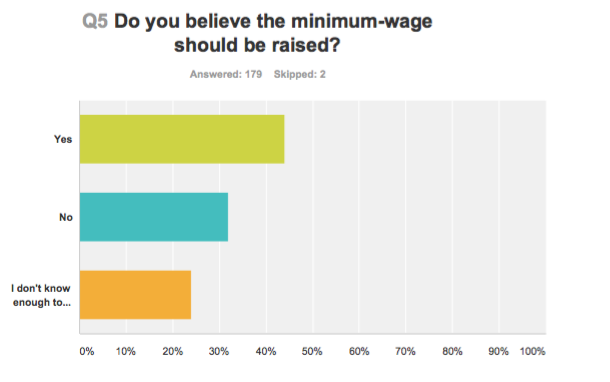
The next question tackled a hotly-debated topic of economics: the minimum wage. Surprisingly, almost half (44.13%) of students believe that yes, it should be raised, and only 31.84% thought it shouldn’t. 24.02% of students said that they didn’t know enough to answer the question, which is actually a pretty hopeful statistic. Over a quarter of kids who didn’t think they had enough information to answer the question actually admitted it, instead of forming an opinion based on others’ without bothering with the facts (something that, unfortunately, happens all too often in politics).
                
The greatest thing about these results is that the voters on each of these questions were pretty much bi-partisan-- that is, to say, that there wasn’t a clear majority of Republicans or Democrats in this pool. 32.58% of voters said that they were Republicans, 35.96% of voters said they were Democrats, and in a surprisingly large representation, 26.4% were Independents. There was even one voter who told me that they were an Anarchist, and that they were ‘serious, Annie, don’t disregard this.’ There was no real party skew to the data-- but if you were to look at all the data without knowing this, you’d say this was probably a poll taken pretty much by only liberals. The truth: the party sizes were pretty evenly split. It is true that not everyone in the upper school took the survey, but the more interesting result is that the students of two major parties who, historically, are on the opposite ends of the political spectrum actually agree on more issues than one would think.

 Quite honestly, the only thing I can truly come up with to summarize this election is that, one, this is pretty much the weirdest election of all time so far-- in real Donald-Trump-is-probably-the-GOP-candidate life, and in Severn-School-picks-Bernie-Sanders life-- and, two, everyone at Severn is a lot more liberal than we (or at least, I) thought. Go figure. 
 

-Annie Mott ‘16

Read More »

Monday, February 15, 2016

Controversy Surrounds Beyoncé’s Super Bowl Performance

By: Neel Lakhanpal '16
Photo Courtesy of Getty Images
A few days after the Super Bowl, many figures have spoken out against Beyoncé’s half time performance, which, although certainly political, is being criticized as anti-police. The lively performance featured the Queen’s newest song, released just a day prior, “Formation.” Beyoncé had not released a single song through all of 2015. She certainly came back in full force, unabashedly featuring Black culture and speaking to police brutality and government ineptitude during Hurricane Katrina in the New Orleans area. While singing, she and her troupe sported decidedly Black Power fashion of the sixties and seventies, not unintentionally doing so in the movement’s birthplace, the Bay Area. The dancers all had natural afros and the classic black beret. All of this was seen as an obvious nod to the Black Lives Matter movement and to empowerment of the Black community through its culture.
Some were not so welcoming of this on the Super Bowl stage. Many were uncomfortable with the hip twirling and Beyoncé’s use of the word “Negro” which was a song lyric in “Formation.” Rudy Giuliani, the former mayor of New York who brought down crime rates in Manhattan using controversial police tactics, was the most notable critic of this performance. Giuliani claimed that this sent a “divisive message,” and that it undermined the respect for cops we must all hold. He remarked that such a prominent national stage ought to feature more “wholesome” entertainment. Bey’s performance was loud and in your face; it was very lively and showcased modern Black culture. But many critics believe this performance too outwardly interwove the Black Lives Matter movement onto the stage, and that such a political and social debate should be divorced from music and occur in other forums. In response, a pro-police group is holding a rally outside the NFL headquarters on February 16th, in an effort to push the organization to not allow the Super Bowl to be used to spread the “anti-police message” the group claims Beyoncé conveyed in her performance. Beyoncé has yet to comment on the matter.
Read More »

Friday, October 30, 2015

Third GOP Debate Recap

By Neel Lakhanpal '16:

The third Republican party debate took place in Boulder, Colorado Wednesday night. It was broadcast on CNBC. Overall, I think the candidates kept their composure in the face of difficult and incendiary questions. There was, in my opinion, a surprisingly even distribution of speaking time among the candidates despite multiple candidates polling well below five percent. I don't think this debate really clarified much. I don't think anyone did bad per se, other than maybe Bush, who looked resigned and seemed to have little energy left in him.

At center stage were Donald Trump and Ben Carson, who are both polling in the twenties and leading the pack. Neither stood out to me; Donald Trump seemed to act normally, albeit a bit toned down compared to a few months ago. Carson was quiet and didn't say anything too surprising. He kept his rhetoric on social issues unsurprisingly conservative, making remarks such as "I am not homophobic because I think marriage must be between a man and a woman."

A few other candidates stood out, notably Ted Cruz. Although I don't think he is a very serious contender, he made an apt remark on the media today. He said that the moderators were attacking each candidate's individual record instead of talking about "substantive issues," which was true to a certain extent. Ohio governor John Kasich also made his name heard, standing out in the first few minutes by escalating his attacks on the frontrunners Carson and Trump. Kasich was quite aggressively shut down by Trump thereafter, though.

All in all, the debate did not settle much. I think it may have brought some candidates such as Kasich a bit more into the foreground. But the two frontrunners remained calm and did not raise any eyebrows. We will look forward to debates in coming weeks to see how they shape the upcoming election cycle.
Read More »

Thursday, October 29, 2015

Editorial: Our Nation's Broken Food System

By: Jack Zuschnitt '16

The American food system is broken. It is corrupt, defective, unjust, and failing. A bag of
deep fried potato chips costs as much as a good piece of fruit. Independent family farms have shifted from being the norm to being a rarity. Corn byproduct can be found in toothpaste, soda, and milk. The vast majority of the miracle drugs, antibiotics, are fed to slaughter bound animals instead of humans. An obsession with efficiency and money has driven the American food system from greatness to embarrassment. The American food system is broken, as evidenced by how industry dominates agriculture, government is consistently ineffective, and consumers are uneducated in regard to food as a whole.


Over the last half century, corporate industry has taken over agricultural trade in what is now called agribusiness. Agriculture is no longer controlled by independent farmers; ​r​ather, it is controlled by mammoth companies, bringing in billions of dollars every year. The natural goal of business is to make as much money as possible, while spending the least amount of money possible. This philosophy is appropriate for most business practices. But in regard to food, it is unacceptable. Food production should focus on quality, not quantity. Food of higher quality tastes better and is better for health. As the documentary Food Inc. asserts, the stated goal of the current food system is to "produce a lot of food, on a small amount of land, at an affordable price.” While this goal may sound acceptable, when our health and that of our environment are severely degraded, a problem arises.


When profit is the only impetus to farm, many sacrifices are made in production and many unorthodox farming techniques must be used. To keep crops healthy, fertilizers are dumped onto crops,​ w​hile all of the extra nutrients run off into nearby water during rain storms. Pesticides are sprayed to kill weeds, fungi, and insects. These pesticides can poison wildlife and wreck havoc on biodiversity. As of 2007, the U.S. was responsible for the use of over a billion pounds of pesticides per year. The theme is clear. As farming becomes more efficient, our environment constantly takes a hit. Another ugly aspect of industrial agriculture is the rising regularity of concentrated animal feeding operations, or CAFOs. CAFOs are places where animals are crammed together, fed unnatural diets, and pumped with antibiotics, maximizing profit while also violating any imaginable animal rights. It is estimated that 80% of antibiotics used in the U.S. are fed to animals. To make it worse, most antibiotic fed animals are not sick at all. This use of antibiotics creates resistant bacteria that could prove to be detrimental to human health. When money is the sole goal of the food industry, an abundance of negative impacts are created. The United States’ government has continuously failed the American food system. Washington has done everything to help out farmers who grow commodity crops (mainly through subsidies) but almost never supports the farming of fruits and vegetables. As David Wallinga, an expert on the food system, notes, “For more than a century, U.S. policy has promoted U.S. farmers’ capacity to increase production, generally of the kind of commodities, ­­like corn, wheat, cotton, rice, milk, and later soybeans,­­ that lend themselves to large-scale production, easy storage, and long­ distance shipping.” He later stresses, “U.S. agricultural policy has generally not offered incentives or supported farmers to grow fruits and vegetables.” In a country where the average adult eats half the amount of daily recommended vegetables and almost double the amount of daily recommended grain, the government must shift its focus to the healthier options of fruits and vegetables.

Along with behemoth industry and a negligent government, America’s food system suffers due to the uneducated consumer. Sometimes, lack of education is to blame. For example, consumers often purchase genetically modified food without knowing so, for labels are not required on GMO products thanks to strong lobbying from big business. In most cases however, consumers only require a quick lesson to see the impacts of the food system. One must simply think about his most recent meal to begin seeing the flaws in the system. Here is an example. Last night, Sam and Sally ate a steak dinner with mashed potatoes and green beans. They purchased said items from their local grocery store, picking the meat and veggies from an open refrigerator (which was a terrible waste of energy). Before making it to the store, the steak, potatoes, and beans were shipped from Texas, Idaho, and California respectively. It takes every meal thousands of miles to make it to the average American’s plate, and most Americans have never even given this idea a thought. Here is another quick statistic: it takes 2,000 gallons of water to process a single pound of beef. As a country, we need to educate ourselves on the basic practices and negative aspects of our food system.

While the American food system is broken, there is a fix. The fixes will not be cheap, easy, or quick, but as issues worsen, the fixes will become necessary. There is no one final fix to the problems of the food system, rather many smaller fixes, but this is irrelevant without the help of the public. As a country, every citizen, business, and government official needs to accept that the food system is flawed and work together to fix it for a common benefit. Citizens’ voices matter, for without the individual, the whole is nothing. Without universal support, the American food system will never recuperate. 
Read More »

Exciting New Club at Severn - SWAG (Supporting Women Across the Globe)

By: Katie Dubinski '18

Every year at Severn, there are dozens of new clubs that pop up at the club fair, on a very wide range of interests. One new club in
particular has piqued the interest of many students: SWAG, or Supporting Women Across the Globe, a feminist based group focused on advocating women's rights. I sat down with the club’s co-leaders, sophomores Yasmeen Meek and Sophie Connors, to learn more about it.

KD: What brought you to start this club?

YM: Well, the issue has always been important to me, for one thing. I've been greatly influenced by my grandmother as well: She was the only girl to go to middle and high school in her village in India, and was one of the only people, male or female, to go to college. She graduated with a PhD in physics. I also am bothered by the way the media portrays women. An article should not be about what a women is wearing but what her ideas are.

SC: At Severn, we have different groups for multiple different aspects of diversity: LGBTQ, racial diversity, etc. However, whenever feminism has been brought up in the past, eyes have been rolled, and for the most part, people tune out. I wanted to raise awareness and educate on the true
meaning of feminism and more importantly, on the violence that women
around the globe face daily.

KD: How would you define feminism?

YM: The dictionary definition is "the advocacy for women's rights on the grounds of social, political, and economic equality to men."

SC: I think that feminism is really about 100% equal opportunities for all genders.

KD: What is SWAG trying to achieve this year?

YM: This club mainly wants to spread awareness through discussions and dialogues and expose people to the problems that women and men face globally due to sexism.

SC: I want to clarify the meaning of feminism and also bring attention to the women across the world who deal with unimaginable suffering because of sexism.
Read More »

Severn Runs

October 17th marked the 14th anniversary of the Baltimore Running Festival. There were over 24,000 participants, whether running the 5k, the relay, the half-marathon, or the full-- and over thirty of them were from Severn. Every year, the Severn Cross Country team trains for and participates in the half-marathon, doing long runs every Friday and building up mileage to get to 13.1.
Training for the half can be difficult. Running is a mental sport-- runners have to push through the pain of injuries like shin splints and tendinitis in order to finish. But it's all worth it. Senior Erica Mott says that running the half-marathon was, "the highlight of my athletic career. It was the most fun I've ever had. People were lined up on the side of the road the whole time, cheering us on."

Although the cross country team has run the half for nine years now, this year was slightly different. Three runners, seniors Archer Willauer and Neel Lakhanpal and junior Camryn Rosen ran the full marathon -- 26.2 miles. To prepare, they increased week by week from fifteen up to eventually twenty-two mile weekend training runs, building up stamina and running for about four hours at a time. "The early Saturday mornings spent training were all worth it. I've never felt so accomplished," says Camryn of her commitment to the extra long runs. Archer Willauer ran the marathon in under four hours-- a hugely significant accomplishment for any marathon runner, let alone for a first-timer.
Whether it's the half or the full, running at that distance is an amazing thing, and Severn congratulates all of the teachers and students who participated.

Read More »

Tuesday, October 20, 2015

Theatre Goers Club: An Inspector Calls

By: Zachary Rosen '16

A few weeks ago, the Severn Theatre Goers club went into Baltimore to see An Inspector Calls at the Everyman Theatre. The play was written in the mid 1900's by J. B. Priestley and follows the story of an Inspector Goule as he questions various members of a family about their involvement in the life of a girl who had just committed suicide (or did she? Do we know? We seriously aren't sure. This play messed me up and I no longer have a full sense of reality).

The play is heartbreaking in its revelation that we all affect those around us, even in the most little of ways that we do not think of. It encourages all of us to respect and love our fellow man and to be careful of what we say and do to others. The acting was superb and the characters were compelling (even the maid, who only spoke once but she had a quietness about her that was horrifyingly unsettling), and it leaves you wondering what kind of person you are.

And the tech was amazing! At the end, the walls pulled up and there were a ton of mirrors everywhere and everyone was looking at themselves and realized what horrible people they all were.

The story ends in a way that is open to interpretation and we really weren't sure what we were supposed to think. Everyone spent the entire bus ride home debating and arguing and it still haunts me.

In any event, the play is no longer being shown at Everyman. However, the Theatre Goers Club is going to Everyman to see a new play, Fences, this November. And if the new show is anywhere near as good as An Inspector Calls, and I imagine it will be, then I encourage you all to go.
Read More »

Wednesday, March 25, 2015

The French Exchange


By: Carley Thorne '17

After a long two weeks in which many Severn students were either relaxing on the beaches of Mexico or skiing down black diamonds in Utah, fifteen families are preparing their homes for the weeks after spring break. 

These small few will act as guides and hosts to the French exchange students traveling on the eight and a half hour flight from Brest, France to JFK in Washington, D.C. 

Elizabeth Grund, sophomore and returning guide for the French exchange program, says that she joined because it was not only an opportunity to expand her language skills outside of the classroom, but also a great way for her to learn about other cultures without having to travel outside the States. “I loved how excited the all of the students were about everyday American things, like fast food, things that I take for granted.” 

Casey Boldt, a junior here at Severn School, said that one of her favorite things about the French exchange was seeing how her student reacted to everyday norms that she didn’t think twice about. “My student was surprised how early we ate dinner and went to bed, in France they eat dinner around ten o’clock.” Casey’s also liked meeting people from around the world and finding out that they aren’t very different from us. 

So this week in school, keep an eye out in the hallways for our foreign travelers and maybe even ask them a few questions about their home-life in Brest, you never know what you might learn.
Read More »

A New Leaf


By: Annie Mott '16

When April rolls around, everyone on the Severn campus is excited about two things: warm weather, and Prom (and, if you're a senior, the fact that this is your last month of high school -- ever). With flowers blooming and prom dress registries booming, the last thing on anyone's mind is Wednesday, April 22nd. Or, as it is more widely known, Earth Day. 

Earth Day, born out of a response to a ravaging oil spill in 1969 in California, has been a remarkable testament to the changing attitude towards the environment in the last 50 years. Just five decades ago, we Americans were sucking up lead gas like we were dehydrated marathoners, pouring smoke into the atmosphere from factories with little regard for consequences, and marring the Earth's surface irrevocably with deforestation and displacement of wildlife. Populations of species decreased at a rate never before seen, and to this day 16,928 species are still faced with the threat of extinction, while 785 species are extinct. 

Earth Day has come to represent America, and the world as a whole, turning over a new leaf (so to speak) and starting the modern environmental movement. 

This year, Severn School is taking full advantage of Earth Day, turning it into an "Earth Week," with a separate activity for each day to make the school more aware of the environment and what is being done to combat the effects of pollution in our ecosystem. 

Specific details of each activity will not be revealed until April 10, during a Morning Meeting presentation, but each day will be something new and different than what we have seen in past years.
For those students who have not yet completed their service-learning hours, a service opportunity over that weekend may prove to be exactly what you're looking for. 

The Earth Week festivities will prove to be a fun way to celebrate and protect our Earth, as well as a showcase for a new, greener, Severn School. 
Read More »